Budget 2026: what it means for housing, landlords and property tax
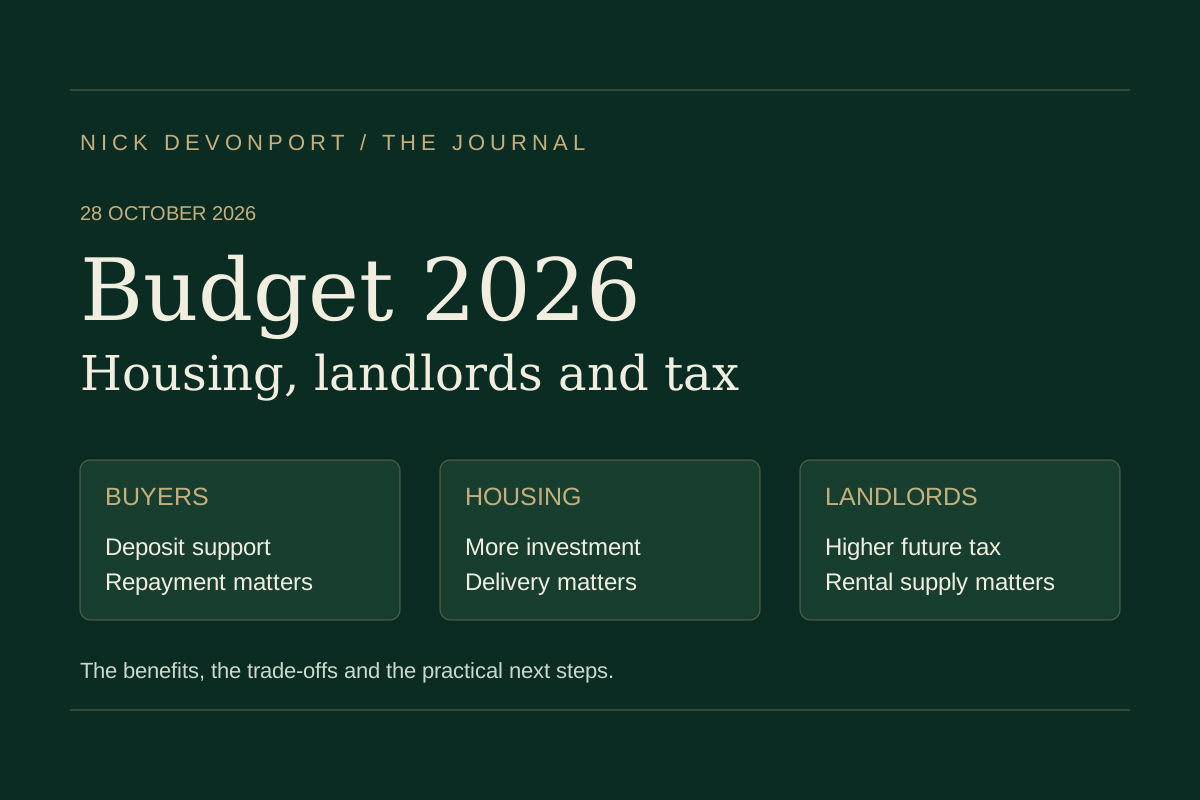
By Nick Devonport, Managing Director · England · Reviewed 28 October 2026
My view is that this Budget offers welcome help for buyers and affordable housing, while creating a further challenge for the landlords who provide rental homes. Both sides deserve a fair hearing.
Today’s Budget offers more help for aspiring homeowners and additional investment in affordable housing. It also asks landlords with personally held rental property to pay more tax from April 2027.
For buyers, tenants and property owners, the result is a mixed picture. Measures that improve access to homeownership deserve recognition. So do concerns about whether further pressure on rental returns could discourage investment in the homes people need.
Landlords: a further increase in property income tax
The government has announced property income tax rates of 24%, 44% and 49% from 6 April 2027.
| Tax band | Current rate in 2026/27* | Previously announced for April 2027 | Now announced for April 2027 |
|---|---|---|---|
| Basic | 20% | 22% | 24% |
| Higher | 40% | 42% | 44% |
| Additional | 45% | 47% | 49% |
*England. Individual circumstances determine which bands apply.
Today’s announcement adds two percentage points to the rates previously planned for April 2027. The total increase against current rates is four percentage points. These are changes to tax on property income, rather than a tax on a property’s value or gross rent.
Sources: HMRC tax policy overview, HMRC rates and allowances, Budget document.
For illustration, £20,000 of taxable property income falling entirely within one band would attract £800 more tax under a four-percentage-point increase, before tax reducers and other adjustments. Of that, £400 relates to today’s additional increase.
That is a simplified calculation, not a forecast of every landlord’s bill. Borrowing, finance-cost relief, allowances and other income can change the result.
The government’s argument is that income from assets should make a greater contribution while tax rates on earnings remain unchanged. It says 84% of income tax payers will be unaffected by the savings and property income rate changes. That gives useful context, although it offers little comfort to landlords directly affected.
Source: HM Treasury’s Budget announcement.
What could this mean for tenants?
Our assessment is that reducing returns could make some landlords reconsider buying, improving or retaining rental homes. Propertymark has also warned that the increase could discourage investment and put upward pressure on rents.
That is a risk rather than a prediction for every property. Rents depend on local supply, demand, household affordability and the applicable legal rules. An increase in a landlord’s tax bill does not automatically produce an equivalent rent increase.
Source for industry reaction: Propertymark’s Budget review.
A functioning housing market needs both accessible homeownership and a sustainable rental sector. People who cannot buy, or choose to rent, still need a choice of well-maintained homes.
First-time buyers: help with the deposit hurdle
The £4.7 billion Your First Home scheme will offer eligible first-time buyers in England 20% equity loans, with a minimum deposit of 2.5% and a five-year interest-free period.
Outside London, the household income limit will be £110,000, with property price limits based on local authority median prices. Eligibility and the final operating rules will matter: buyers should not assume every home qualifies.
Source: Budget document, housing measures.
This could help buyers who can sustain mortgage payments but struggle to save a deposit. However, an equity loan is repayable support, not a grant. Buyers should understand repayment terms, later interest charges and their total borrowing commitments.
Our assessment is that deposit assistance works best when accompanied by more homes. If purchasing power rises faster than supply, some of the benefit can be absorbed into prices.
Affordable housing: welcome investment, with delivery still essential
The Budget provides an additional £1.5 billion intended to deliver around 10,000 homes in England, prioritising Social Rent, particularly council housing.
Source: Budget document, affordable housing investment.
More social housing can give households greater security and broaden the options available to people struggling with housing costs.
The practical test will be delivery: suitable land, planning, infrastructure, construction capacity and completed homes. A national funding commitment should not be read as a promise of a specific number of homes in Gloucestershire.
Other property tax and administration points
The Budget also sets out:
- More regular, automated in-year Self Assessment payments from April 2029 for taxpayers who make payments on account. Detailed implementation work will continue.
- Further arrangements for the planned High Value Council Tax Surcharge in England, including deferral, exemptions and an empty-property premium.
- Legislation to remove Stamp Duty Land Tax on rent under assured tenancies in England, with effect from 1 May 2026. This concerns tenancy rent, rather than a general cut in purchase stamp duty.
Source: HMRC tax policy overview.
What should property owners and buyers do now?
Landlords should update their cash-flow forecasts for April 2027, including tax, borrowing, maintenance and periods without rent. Ownership structure deserves individual advice: moving property into a company should not be treated as an automatic solution.
Buyers should assess affordability across the full life of any mortgage and equity loan, including costs after an introductory period ends.
For Gloucestershire, the useful questions remain local: what homes are needed, what households can afford and whether development and investment can deliver them.
The Budget makes a positive contribution through buyer support and affordable housing investment. Its weakness is the risk that additional tax pressure discourages private rental provision. Success should be judged by completed homes, sustainable ownership costs and better choices for tenants.
Based on Budget documents published on 28 October 2026. Announcements and proposed legislation are distinguished from existing rules; implementation details may develop. General information and commentary, not individual tax, legal or mortgage advice.